
-
Teflon


Who first made it? What is the monomer? What are its uses?
Teflon is a synthetic fluoropolymer, formally known as Polytetrafluoroethylene, whose repeating unit consists of two carbon atoms, each attached to two fluorine atoms. The polymer is formed by the polymerisation of the monomer Tetrafluoroethene, composed of two sets of CF2, joined with a double bond.
Teflon first appeared in 1938, in the DuPont company’s Jackson laboratory, discovered by Roy Plunkett (1910 – 1994). Plunkett was researching ways to create refrigerants from chlorofluorocarbons, to replace the previous versions which used sulphur dioxide and ammonia. When he had a large volume of tetrafluoroethylene gas stored in a number of cylinders, it was found that – at sub-zero temperatures – the gas had become a white powder with low surface friction, chemically inert and heat resistant.
Teflon’s major selling point was that, by virtue of the strong bonds between carbon and fluorine atoms, it will not easily react or stick to other substances. It has thus been hugely successful as a coating for non-stick pans, gears, windscreen wiper blades, carpets and electrical wires.
-
Recycling Symbols


The meanings of recycling symbols on plastics.
Modern plastic products are often labelled with recycling symbols. These symbols are based on the types of polymers from which the objects are made.
Number One Plastics
This logo is placed on products made from polyethylene terephthalate. This is found mainly in food and drink bottles and can be recycled into fibre, carpet or panelling.
Number Two Plastics
This logo means High Density Polyethylene, which is found in cleaning product or toiletry bottles, as well as liners. They can be recycled into pens, drainage pipes, lumber or fencing.
Number Three Plastics
This refers to vinyl or polyvinyl chloride products, such as detergent bottles, food packaging and medical equipment. It is difficult to recycle due to toxic chlorine content, but can be made into mats, flooring, cables and decks.
Number Four Plastics
Low Density Polyethylene. These plastics can be found in frozen food, clothing, shopping bags and furniture. It can be recycled into floortiles, bin liners and shipping envelopes.
Number Five Plastics
Polypropylene is found in caps, straws and bottles. It can be recycled into cables, brushes, pallets, trays and lights.
Number Six Plastics
Polystyrene products include disposable crockery, CD cases, egg cartons and medicine bottles, which can be recycled into isolation, stationery and foam packaging.
Number Seven Plastics
This category includes various polymer products such as nylon, DVDs, and sunglasses. They are not commonly recycled, though they are sometimes turned to lumber or miscellaneous custom products.
Sources: thedailygreen.com; Recycle Plastic Limit
-
Trotsky’s Role in Red Victory

 A one-page reply to the question “To what extent do you agree that the leadership of Trotsky was the main reason for the Reds’ victory in the Civil War?”
During the Civil War of 1918 to 1920, Leon Trotsky became a prominent military leader for the Bolsheviks. He has been credited with forming the Red Army from virtually nothing, and of managing the entire Russian Communist war machine by use of superb tactical skills and propaganda.
In the early days of the war, Lenin placed Trotsky in control of the Bolshevik forces and appointed him “Commissar of War”. Trotsky initially described the Red Army as a “flabby, panicky mob”, and was quick to make changes. He is most remembered for his strict discipline: Anyone who disobeyed orders, or deserted their posts, would be shot. This was in strict contrast to the whites, who had little or no discipline at all and were constantly squabbling amongst themselves. Indeed, most of Trotsky’s success could arguably owe more to the incompetence of the whites than to his own brilliance – that is, the tactics which led to the Reds doing so well stand out principally because the White tactics were so poor. Whereas the Whites had multiple armies in a weak alliance, the Reds were unified in their aims. While the White leaders were drunk and disorderly, the Reds had strict disciplinary measures. The Whites had little or no communication, the Reds had Trotsky’s war train to carry orders and news.
All of this begs the question of whether the Bolsheviks would still have has the upper hand without Trotsky’s involvement. Certainly, the Commissar of War played an important role, personally directing practically the entire war. We must, however, acknowledge that the Bolsheviks had many other factors on their side, and so perhaps Trotsky’s strategies, brilliant as they were, might not have been as essential as many remember. In fact, given how his career ended, it might have been all the better for him, too.
-
Chariot Racing


A summary of the information about chariot racing that can be found in Ovid’s “Amores”.
The races were held in an oval-shaped stadium. The charioteers would usually have four horses, decorated in the colour of their respective faction (white, green, purple, gold, blue and red)*. The teams began the race behind a starting gate, to be released by the preator. After each lap had been completed, the supervisors of the event would turn over one of a series of miniature dolphins. The last dolphin would be turned over when the race ended.
Unlike in the ampitheatre, the stands at a chariot race had males, females, adults, children, masters and slaves sat together. Before the race began, there would be a procession of the gods, in which statues of various Roman deities would be wheeled out. Those mentioned in the Ovid extracts are Neptune, god of the sea; Mars, god of war; Phoebus, Phoebe, Minerva, Ceres, Bacchus, Pollox, Castor, and Venus. Spectators would use this time to cheer, and pray that their faction would win. Should one of the charioteers make a false start, or have to be stopped, the citizens of the crowd would flap their togas in disapproval. Due to the often violent nature of the races, charioteers would tether themselves to the reins to avoid falling off after hitting an opponent. In case this instead led to them being dragged along the ground at high speed, they would also carry a knife to cut the reins away, though this still left them open to being trampled by another team.
*Initially there were four teams. Under Domitian, more were briefly added including purple and gold.
-
Dangerous Minds in Duffy Poems

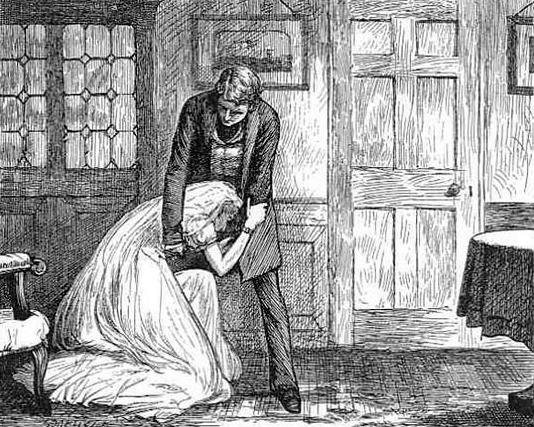
Whilst “Education for Leisure” and “Salome” portray disturbed and dangerous minds, “Havisham” and “Stealing” offer portraits of pitiful individuals worthy only of sympathy.
There may be an element of truth to this statement: all four of the poems mentioned are centred around individuals who have been mentally scarred or damaged in some way. The speaker in Education for Leisure, having been subject to a life of unemployed boredom, has developed delusions of greatness, along with a lack of caring for life, seemingly leading towards murderous habits. That of Stealing, meanwhile, has become obsessed with the titular pastime, even stealing bizarre and mostly pointless objects just so as to spite their owners. The eternal bride Havisham has locked herself in a darkened bedroom for over a decade, constantly reliving her failed wedding and building up a deeply misandrist complex, while the promiscuous Salome sinks into a web of cheap sex and (possibly) homicide. The question is of whether the distinction made in the statement about the aforementioned pairs of poems is legitimate.
It is true that, overall, Salome and Education for Leisure take on a darker tone than the latter pair, with the events taking place in the narrative reaching actual killings by the heroes. Salome’s thoughts of “[She]’d done it before / (and doubtless [she]’ll do it again, / sooner or later)”, while ambiguous as to whether “it” means casual sex or cold slaughter, make it clear that she is indifferent towards others, a point reinforced by her relatively nonchalant reaction to realising that her sleeping partner is only a severed head! In Education for Leisure, the speaker is shown to have clear homicidal intentions; considering themselves to be superior to all other forms of life, and killing small animals for entertainment before finally heading out to wound the pedestrian reader with a bread-knife.
On the lighter side (relatively speaking), Havisham’s desire to see all men given deadly punishment for her fiancé’s desertion are restricted to insane fantasies, trapped as she is in her dressing room. The thief in Stealing also is comparatively tame as, though clearly sadistic in their extraction of joy from the knowledge that they will have made children cry, they never express a desire to actually kill, apart from inanimate objects whose only “life” was that given to them in the thief’s mind.
At first glance, then, the opening statement appears to hold some value, however some of the backstory given in the four poems begs to differ. In Education for Leisure the speaker is shown to be living a seemingly pointless, empty life. Having fallen victim to the system and been abandoned by humanity, they have been forced to construct a fantasy life for themselves in which they are a celebrity and the contents of their daily routine are a series of heroic adventures. Their apparent lack of concern for life may be a response to life’s lack of concern for them, since they have clearly not been lucky in society. In any case they are not stated outright to have killed anything larger or more sentient than a goldfish, and it is not revealed whether or not “I touch your arm.” ever does in fact become “I kill you.”. For all that we know, they could have eventually come to their senses and not actually performed the murder. Likewise, Salome is not shown to kill at all since, up until the reveal in the final stanza, there are only a few oblique hints at a darker meaning in what otherwise could easily have been a poem waking up after a drunken sexual encounter. Also, though evidently somewhat jaded towards the sight of a severed head next to hers, has not done anything worse than get out of shape.
Havisham, on the other hand, deserves far less sympathy. While the other characters clearly had issues, hers go beyond mere delusions and obsessions into a passionate desire to see half of the world’s population destroyed to satisfy her personal problems regarding having been jilted at the altar. The speakers in Education for Leisure and Stealing both made enemies of society as a whole because they were hurt by society as a whole, but Havisham’s habit of sexual profiling is making her want to make all men pay for what one man did to her, and it may well be only that very same insanity which, by trapping her inside, has prevented her from doing so. I do not believe that she should be allowed “victim” status, as she is clearly a self-centred psychopath. Bearing in mind that within the poem itself gives no explanation as to why her boyfriend abandoned her, it may well have been her own fault, in which case her entire battered woman premise is simply a delusion which she has constructed to satisfy her misandry and sadism.
Based on the preceding points, I do not agree with the opening statement. In my opinion, Havisham belongs in the former category of “disturbed and dangerous minds”, while Salome is far closer to the latter. While through their own thoughts each character is presented in a way that agrees with the initial statement, my evaluation reveals that they most certainly do not.
-
Causes of the 1905 Revolution


An essay on the factors which led to the Russian Revolution on 22nd January 1905
Bloody Sunday saw the Winter Palace in St. Petersburg marched upon by 200000 Russians, led by Father Gapon, a priest, in an ill-fated attempt to petition Tsar Nicholas II for change. In their petition, they outlined the problems with Russia’s political and economic systems, then requested that the Tsar make some changes which might improve their lives. In theory, things might have gone well from their efforts, but in practice all went horribly wrong: Nicholas, thinking that he was under attack, fled from the Palace and sent troops to control the crowd. Ultimately the petitioners were massacred. This sparked off the 1905 revolution, an 11-month series of strikes, riots and assassinations. Of course, the massacre was only the final straw in the build-up to the revolution, notable in which was Russia’s war with the Japanese.
The location of the Russian Empire mean that it was rarely a pleasant temperature, with the vast majority of the land being largely uninhabitable. In particular, Russia’s eastern parts spent six months of every year completely frozen, making it virtually worthless. Nicholas II therefore decided to capture the slightly warmer Port Arthur. Apart from its strategic usefulness, the capturing of the territory would, it was hoped, distract the Russian populace from the wide array of problems with their society and reactivate a sense of patriotism and Tsarist loyalty. What this shows us is that the Russian people were starting to lose faith in the Tsar, and this was starting to lead to civil unrest. The problem with Nicholas’ idea was, again, that it caused precisely what he wanted to prevent. Having decided on this plan to capture the nation’s heart through a grand victory, he had not realised how hard that victory would be to achieve. As it happened, Russia was defeated with embarrassing ease. This meant that, rather than improving the lives of his subjects, the Tsar had made them worse (by spending much of their pittance on the war), thus plunging Russia into economic problems, and turned his people against him. The reason this event is significant is that it exposed the ineptitude of the Tsarist rulers and caused the people to become aware of his flaws, as well as how they were holding the country back. We still, however, have not reached the long term causes behind the revolution, and they had been building up for a long time.
In an era when the western world was seeing a huge industrial leap forward, and improvements in the quality of proletarian life, Russian society still used a structure not seen since the middle ages. The society used the feudal system, whereby most of the population were peasant farmers who served the Tsar and aristocracy. Russia also still had medieval technology on the farms, and so the yield was always disappointing compared to farms from Western Europe.
The effect of this backwardness was to make Russia a weak nation, and a poor one. The peasants (80% of the population) lived in poverty and, though indoctrinated by the Orthodox church, were developing a dislike of the system and the Tsar. The industrial workers, meanwhile, were also finding that they were being overworked and underpaid, while the middle-class capitalists wanted more power for themselves. The problem was that Nicholas was a firm believer in absolute autocracy and would not hear of autocracy or reform. This was obstructive because while he believed he alone should be allowed to rule, he was terrible at ruling: Being too concerned with the minute details of government to look at the country overall and take a direction for it. As a result, the empire continued to decline, to fall behind Europe and to become dissatisfied with its leaders.
Overall we can see that the reasons for the 1905 revolution have a deep story behind them. The longterm problems with the insufficiency of Russian technology and its antiquated social structure were the foundation for Nicholas’ decision to wage war with Japan, which in turn built up to Bloody Sunday. A common theme in all of this is the Tsar attempting to set his country right… and failing spectacularly. While it shows he occasionally had moments of good intentions and lucidity, ultimately they showed his lack of commanding talent. Another theme was the Tsar’s inability to acknowledge the needs of his subordinates when they tried to communicate them. At a speech in the White House in 1962, John F. Kennedy said
“Those who make peaceful revolution impossible make violent revolution inevitable.”
and this is precisely what happened in Russia. By violently stamping down on all attempts to negotiate with him, the Tsar made it impossible to peacefully fix the problems of the country. Talking only works so long as people are willing to listen, and Nicholas wasn’t. By the end of Bloody Sunday, it had become clear that no amount of peaceful negotiation would break through Nicholas’ authoritarian, closed-minded ignorance, so the people decided to see if actions would speak louder than words.
-
Why the World Went to War in 1939

 An essay on the actions of Hitler, the Treaty of Versailles and the Nazi-Soviet pact.
At the start of September, 1939, the Nazis began an invasion of Poland. The leaders of France and Great Britain responded with a severe declaration which, in retrospect, is known to have been the start of the Second World War…
The irony of the circumstances is that, for the last twenty years, all the powers in Europe and America had been trying their hardest to prevent an international conflict from occurring, yet they had unwittingly started it. The reason for their part in this achievement* can be traced back to the end of the First World War. With all the major European states having lost a significant proportion of their wealth, goods and indeed population to the fighting, they were quick to pounce on any hope of paying back the massive costs. Inevitably, the bill was given, via the Treaty of Versailles, to the losing side. For the “good guys” (mainly Britain and France), this was seen as a reward for their victory, and as a punishment for the Germans. In their eagerness to milk the circumstances, however, they set up a series of further international conflicts for years to come. Their mistake was that they punished Germany far too much, in the hope that it would teach the Germans a lesson, but instead the bitterness held by the German people, further amplified by the economic disaster that resulted from their attempt to pay off the reparations, made them hungry for revenge. In particular, the Treaty practically took away all of the territorial and military power that Germany had built up over the previous years. Remember, in 1914, Germany’s motive for starting the war was to compete with the imperial height of its neighbours, with all the major European nations (plus Russia) having controlled vast empires either at the time, or at some point in history. By taking away all of what Germany had accumulated in the forty years since its formation, the Treaty effectively reset the country to its original status, not realising that this would obviously lead to history repeating itself…
Though the Treaty of Versailles had started the chain of events, another element would be required to carry them forward. This came in the form of Adolf Hitler. He had fought in the trenches, and was distraught by Germany’s defeat, so he set up the National Socialist party to make the country strong again. Even at the time, some of his visions and ideas may have seemed somewhat unrealistic (the “Aryan” race, for instance), but with 350 marcs equalling one British penny, and the German infrastructure in tatters, people could only look to extremist parties for salvation. What’s more, in the short term at least, their dreams came true. Hitler repaired the nation’s broken economy, rebuilt their industries, ended the hunger, and restored Germany’s military. There was only one piece remaining: the Empire. In order to complete the picture, and to unite the German speaking people, Hitler would need to take control of a fair deal of European territory, meaning he would need to invade other countries. In the beginning, this was easier than you might imagine.
One of the terms laid out in the Treaty in 1919 was the establishment of the League of Nations, a union between several European powers designed to manage problems around the continent and ensure that, from then on, peace could be maintained. However, the plan never really made it into reality, because the League could never organise itself.
Firstly, despite their president having suggested it, the Americans never joined the League of Nations, which left it seeming incomplete, with no-one to “bridge the gap” between European powers. Secondly, Germany was not allowed to join for many years, thus adding to the resentment that the Germans felt. this exclusive act ensured that Germany could not work together with the other countries, and so would remain an enemy (actually, it rather encouraged the Germans to go to war since, if the purpose of joining the countries together was to prevent them from attacking each other, keeping Germany out effectively made them exempt). Thirdly, the powers which did become part of the League never learned to co-operate. The representatives of its members (particularly France and the UK) were concerned only with advantaging their individual countries’ own governments, rather than working as part of the greater whole. This meant that the League remained weak, especially in that while various members had vast imperial and military might, the League itself had no army, and therefore little in the way of authority. As a result, misbehaving members could not be dealt with severely (or, indeed, at all), so when Hitler sent in the troops to capture the Rhineland, Austria, and Czechoslovakia he was virtually unchallenged. Far from the harsh punishment they had unleashed upon the Fatherland in 1919, Britain and France were sympathetic to Hitler and thought that if they “appeased” him, he would eventually be satisfied – Chamberlain even had a note from Mr Adolf to prove it – but when the Nazis invaded Poland they finally realised that their plan had failed.
There is, however, another reason for the League’s inability (and even unwillingness) to oppose Hitler, one far more specific than a general lack of confidence and competence, and it came from the far end of Europe. Having overthrown the oppressive Tsar regime during WW1, the soviets had set up a vast communist expanse in what had been the Russian Empire. The aristocratic Britain and the other capitalist nations were afraid of this new ideology becoming a threat to their ways, and would give anything to fight Stalin off. Unfortunately, the other end of the spectrum was not to promising either, with Hitler and Mussolini quickly establishing great fascist dictatorships. With super villains left and right (politically speaking), many of the countries’ citizens were torn as to which was the greater of the two evils, and thus the main priority. Ultimately Britain and France sided with the U.S.S.R. for the time being, in the hope that it would have kept Hitler at bay. But then, in August 1939, the two enemies signed a non-aggression pact (as well as a deal to split Poland between them). The Allies were shocked that two men of such different ideologies (and moustaches) could make such an agreement. Furthermore, the pact meant that Stalin had betrayed the rest of Europe, who had been relying upon him to protect them against Hitler**. Now the Nazis were free to set about world-domination. I believe that, overall, this is the crucial reason as to why Hitler’s advances were not stopped, and why, by extension, the world went to war once again.
*That is, becoming the first to make this paradox occur outside of science fiction.
**Though Stalin was, in turn, betrayed by Hitler 2 years later.
-
History of Mathematics
Two presentations, one about famous mathematicians, the other about famous arithmetic problems.
Error: Content Missing
-
How “Blackadder” Portrays the Commanders of the First World War

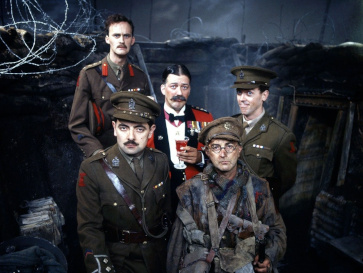 The officers shown in “Blackadder” are all rather thinly veiled caricatures of the real life men. A common trait shared by all of the officers (except Captain Blackadder) is an inability to realise the stupidity and futility of their plans. General Melchett, in particular, seems to view “going over the top” as something of a joke, rather than the horrific experience that we know it to have been, even sending Darling to his death as “special treat” in the final episode. He, like many men of the time, is keen to send others off to the front lines while he, being “too old and too fat”, stays far behind at HQ. Captain Kevin Darling seems to be aware of the horrors of the trenches, and it is obvious that his constant toadying around Melchett is part of an effort to stay as far away from the front lines as possible, even enduring a torrent of abuse from other officers (such as being asked if he unloads lorry loads of paper-clips , in order to maintain his position of relative privilege. Lieutenant George, meanwhile, seems blissfully ignorant of the hell-hole in which he lives. He falls instantly behind most of Melchett’s plans, and seems to be filled with the artificial spirit of war which seems to have been so common in this period. Douglas Haig himself, of course, has only one actual appearance, in which he is seen sweeping soldiers off his planning table, but he is certainly implied to be inflexible and backward, with little regard for human life. Last of all, Squadron Commander Lord Flashheart, of the Royal Flying Corps, seems to relish in the “adventure”. Far from being desperate to get out of the war, he loves showing off to the other soldiers and any women present. Though while rescuing Blackadder he quietly admits that he hates the war as much as Edmund does, he retracts the statement a moment later. We can infer that he actually sees as plainly as Blackadder, but is simply having a better time of it than him.
 -
Stem Cells


An explanation of the difference between adult and embryonic stem cells, writing about the benefits of using stem cells to treat disease, and discuss concerns about their use.
Embryonic stem cells are cultures of cells taken from the inside of embryos (1). Embryonic stem cells can become any of over 200 different cell types found in the body (this is known as pluripotence). ES cells are easy to grow in cultures, and are generated by transferring cells from a preimplantation embryo into a petri dish filled with a culture medium (2).
Adult stem cells are found within an organ or tissue. The majority of the cells around them are differentiated, but an adult stem cell is not, though it is not pluripotent to the same degree as an embryonic stem cell, as it can only differentiate to the specialised cell types used within that particular organ or tissue. The primary role of adult stem cells is the maintenance and repair of the tissue which they are in. AS cells are harder to grow in culture than ES cells, because they are comparatively rare within mature tissue, which makes them difficult to isolate.
It is also believed that, if obtained, adult stem cells would be less likely to be rejected after transplant, because a patient’s own cells could be more easily forced to assume a specific type of cell, and they are recognised by the patient’s immune system (which therefore does not need to be suppressed with drugs).
The basis of using stem cells to treat diseases is that because they are undifferentiated, they are extremely malleable, which means that they can be developed into many different varieties of body cells. When the method of manipulating stem cells is mastered, it would theoretically be possible to artificially generate healthy body cells. The effect is that the treatment would help repair damaged tissue, which is often weaken by diseases such as Alzheimer’s, heart disease, diabetes, arthritis and osteoarthritis. The ultimate aim of stem cell research is the ability to completely regrow damaged tissue and organs, so that patients need no longer be left waiting for replacements to be donated. To the general public, stem cell research is often regarded as a way to stop the effects of ageing. This is to some extent true, as stem cell treatment would counteract the steady deterioration of old cells caused by the cumulative effects of poor cell division.
There are still numerous concerns surrounding the use of stem cell transplants, both scientific and ethical. Many of the scientific concerns are about the difficulty of getting the process exactly right, and thus the potential for complications.
One concern is that, in order to avoid the patient’s body rejecting the transplant, their immune system has to be deactivated. This makes them especially vulnerable to disease, and so any viruses present in the transplanted cells could easily overwhelm them. The chance of this is increased by the use of animal cell sources, which could contain diseases which we are not currently able to detect.
Another concern is that the fast growth of embryonic stem cells is difficult to control, and excessive growth of the wrong cell types could result in tumours, similar to the effects of cancer.
The ethical concerns about stem cell research are centred on where the cells are sourced. Originally, stem cells were taken from donated embryos (usually the by-products of assisted fertilisation attempts), but the UK law has recently been changed to allow scientists to create artificial human embryos for their research. Some have argued against this, on the basis that an embryo is a human life and should not be used as a mere scientific tool.
Controversies have since arisen as to the moral rights of the embryo. The Catholic Church, in particular, maintains that a foetus, or even a fertilised ovum, should hold all the human rights that a person does. Those of less absolute values are debating the exact point in its development at which a foetus becomes a person. The general consensus at present is that embryos can be used if they are less than two weeks old (which is essentially a small cluster of cells), though there will likely be many shifts in perspective throughout the years to come.
- Normally in the early stages of development
- Such as agar or gelatine
_-_Teflon_(49615920942).jpg)


 Homework Direct