
-
The Origins of Energy
An explanation of how the energy stored in coal, oil and gas originally came from the sun.
All of the energy contained within coal, oil and gas originally came from the sun. Ten million years ago, plants used sunlight for Photosynthesis, converting solar energy into chemical. Later, the plants (and animals which may have eaten the plants, or at least eaten other animals who had eaten the plants, etc.) died and their corpses were submerged under layers of sediment, and as they fossilised, then disintegrated, their bodies turned into coal and oil, with bodily gases forming pockets under the sea. These substances were then harvested, refined and burned, with the chemical energy now being converted into heat (some of it back into light), then kinetic energy, then electrical energy. See the image below to illustrate the point.
Error: Image missing
-
Dante’s “Inferno”

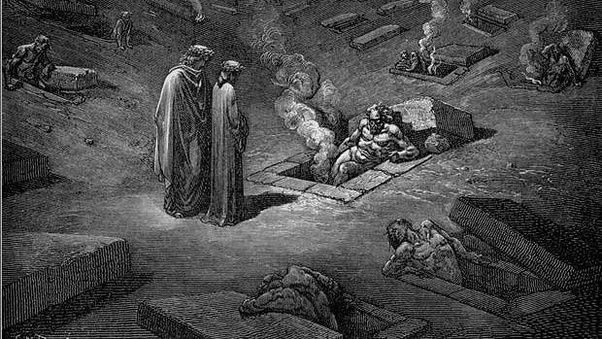
A description of the Nine Circles of Hell.
Dante’s Inferno is the first part of Divine Comedy, a poem written by Dante Alighieri, an Italian poet, in the fourteenth century. Inferno is a fictional recount of Dante’s journey through the Nine Circles of Hell (as the medieval people envisioned it).
The First Circle
Limbo, Dante found the atheists; people who had never been baptised and despised Christianity. The first circle is not particularly horrific; in fact, Limbo is rather like a grassy meadow. This circle is designed to show atheists (who may not technically have sinned) that they can never quite reach heaven.
The Second Circle
Lust, is, unlike Limbo, a place of true punishment People who, in life, have grown so in love for another that they have lost their minds, having been completely overcome by sexual temptation. Their souls are forever caught in the winds of a violent storm, never to rest.
The Third Circle
Gluttony houses people who have overindulged in various addictions and grown uncaring of others. The gluttons lie in a foul slush, guarded by a three-mouthed monster.
The Fourth Circle
Greed is the place home to the souls of those who have fallen victim to great greed over their lives. Their souls are split into two groups: The Avaricious who hoard money and the Prodigal, who mindlessly throw it away. These two groups are forced to joust each other, using enormous sacks of money as weapons.
The Fifth Circle
Wrath and Sullenness is home to an eternal fight amongst the wrathful on the surface of the river Styx, beneath which lie the sullenly who are locked in a place where they can find no joy in God or the universe.
The Sixth Circle
Heresy is filled with flaming tombs, housing those who do not believe in any afterlife at all. These heretics are completely dead, with no thought, no feeling and no future.
The Seventh Circle
Violence is split into three rings. In the outer ring, reside the souls of people who are violent against people and property. Their souls are thrown into the river Phlegethon (boiling blood). In the second ring, the suicidal are turned into gnarly bushes and trees, which are then eaten by Harpies. In the innermost ring, the blasphemers are left in a desert where flaming flakes fall from the sky. This circle is guarded by the Minotaur.
The Eigth Circle
- Seducers are marched in all directions by demons for eternity (like they used other people’s passions to make them do their bidding).
- Flatterers are imprisoned in piles of human excrement, representing the empty words they used to manipulate people.
- Simoniacs (people who buy their way into high religious positions) are locked in stone stocks while their feet burn.
- False prophets, astrologers and sorcerers have their heads twisted around by 180 degrees so that they could not see ahead of them, and thus had to walk backwards (magic is twisted).
- Corrupt politicians are thrown into a lake of burning pitch.
- Hypocrites (those who hold fake beliefs) walk around wearing lead cloaks which “weigh them down and make spiritual process impossible.”
- Thieves are bitten by snakes and lizards, while being transformed into many different shapes (their identities are stolen). They are guarded by Carcus, a centaur with a fire breathing dragon on his shoulder.
- Evil councillors (who use their positions to engage in fraud) are each concealed in their own flame, where they burn forever.
- Those who cause angst and divide other people are continually hacked to bits by a demon.
- Falsifiers (who, in a nutshell, spread lies) are ripe with diseases.
The Seventh Circle
Betrayal is the final (and therefore presumably worst) circle of Hell. The ninth circle is split into four rounds, depending on what sort of traitors its inhabitants are:
- In the first round, traitors to their own kindred are submerged in ice from the face down.
- Those who betray society are imprisoned in round two, where their heads are feasted upon.
- In the third round, traitors to their own guests are also locked in ice, their bodies possessed by demons.
- In round four, people who have betrayed Christ are completely encased in ice.
Waist deep in the ice, in the centre of the ninth circle, is Satan (three-headed) who bites and claws at his three prisoners: Judas, Brutus and Cassius (who assassinated Julius Caesar), beneath Satan is the centre of the earth, Dante and Virgil’s escape route from Hell.
-
Was John a Bad King?

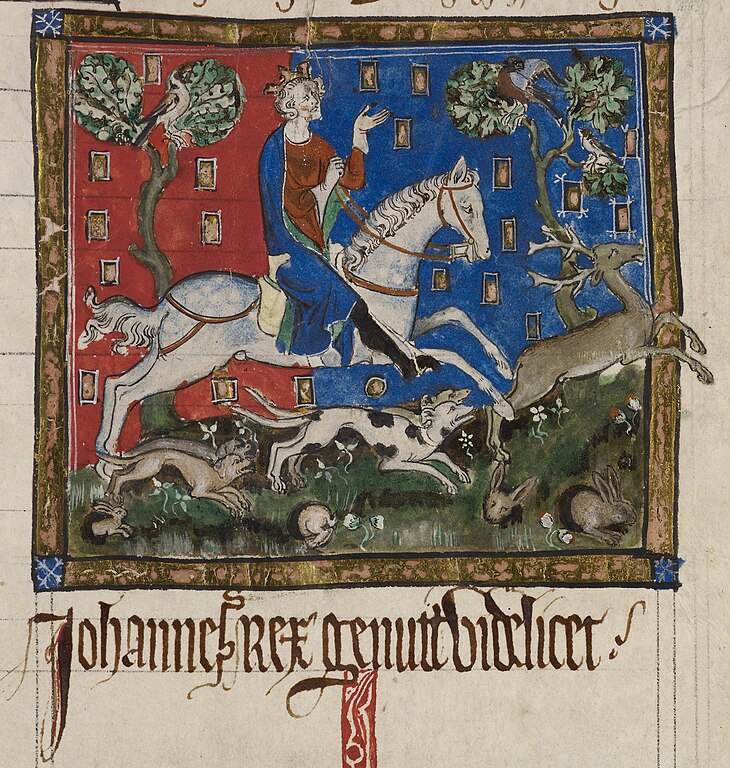 An essay on the merits and failures of his personality and politics, with notes on the public perception of him.
“Yes” is the typical answer to this question. King John has forever been portrayed as a wicked, vile ruler of England, who taxed the country out of everything they had and despised his own people. But then King Henry VIII went down in history as on overweight thug who attacked the Roman Catholic Church and went through six wives, two of them he executed! Edward the Confessor went down as a pathetic excuse for a king who could never stick to a decision. Marie Antoinette, wife of Louis XVI of France, doesn’t get seen as much of a great figure either after her reaction to the peasants’ famine and Mary I wasn’t very popular with the British Protestants, whom she burned at the stake. It’s hard to think of any royal figure throughout history who has been particularly nice to their people, and who therefore has been recorded as “good”. All kings and queens up until the current Elizabeth II (who, when you think about it, doesn’t really get to be queen at all) were apparently “vile, cruel and greedy”. John, then, may well turn out to be no worse than any other historical king, not that we should let him off the hook straight away of course.
General opinion of King John has changed over the years from angel to devil, then back to angel. Walt Disney, of course, went straight for the villainous John, the evil John as the character for the Robin Hood film. Chances are, they were aiming purely for entertainment value with little or no regard for historical accuracy. This is understandable: a Disney film will never realistically be a historical documentary, any chance of that disappeared the moment the decision to have animal characters was made, so the only way they could succeed in making a good movie was to go for a pantomime villain. So they did. In the movie Prince (not yet king, you’ll note) John is a greedy fool, who is incredibly gullible and therefore easy to rob: when little John sucked all of the jewels from his rings, Prince John didn’t even notice. He also fell to pieces at any mention of his mother. I doubt that this had any relevance to the real Prince John.
Because Disney is not an established historical documenter, and most historians judge past events against their own time periods, the contemporaries of King John seem like a good source of information, providing the sources haven’t been tampered with over the centuries. Most of the contemporary passages are rather critical of King John, for instance “John trusted strangers but not the people he rules over.” were the words of one monk who thought John was a poor leader. It is also strongly suggested that John had a great loathing of religion, and apparently said that priests were “public enemies” before banishing them from England. Another aspect often applied to John is typical royal greed. Historical records from the time state that he heavily taxed the whole country, bleeding dry everyone from the lowest peasants to the richest lord and lady, he even made the barons pay “scutage”. This is not looking good for John.
These people, however, cannot be given my full trust before we look closer at who they really are. In order to be John’s contemporaries, they would have to have been his people, or to put in another way, his victims. They had to endure typical king’s cruelty such as taxes, wars, execution etc. This makes them likely to see John in the worst light. There will not be many contemporary sources which portray John as a good character, as like most kings/queens he was the enemy of the people. He was, in particular, the enemy of all monks and Barons. He taxed the Barons, he ignored the needs of the church and he banished all of the monks from Canterbury, calling them “public enemies”! So it seems reasonable that they should call him a “poor leader” and a “tyrant”. Likewise, the Barons had not respect from John, who denied them their power and nearly started a civil war (the less said about him seducing their sisters and daughters the better).
Of course all kings have their good points (somewhere) and John did make several changes to England for the better, he reinforced the British Navy, for instance and introduced a new, presumably better, monetary system to make government finances easier and he revamped the country’s law courts. John also took control of Scotland, Wales and Ireland, thus bringing relative peace to the realms of Britain. To damp down the flames of the Barons I’m afraid I have to resort to saying that he raised taxes and killed those who disagreed with him by saying he had to. The wars of the Holy Land were raging, and Britain was under threat, John couldn’t afford any slip-ups, everything had to be perfect. Money was to be no obstacle, there could be no compromise in King John’s plans, and if money was needed to pay for a war then the Barons would have to cough up! Likewise, when John went to war, he couldn’t let God get in the way of his plans, he didn’t have time to pray before battle and most of the amendments would have gotten in the way of the mere action of killing the enemy, of taking their land, thus the only way to be successful was to dispense with religion altogether. The same may also apply with his ignorance of his Magna Carta agreement. Overall, he was just a man determined to get his job done, and nothing was going to stand in his way!
Historians’ opinions of King John have fluctuated over the centuries depending on what was fashionable at the time. In Tudor times, people supported King John because he attacked the Catholic Church as Henry VIII had done (or rather, Henry declared that the Catholic Church was bad, and that King John was therefore good, forcing schoolmasters to pass this on to their pupils) whereas the people of Queen Victoria were used to being in the capital country of an enormous empire covering a quarter of the Earth, thus they despised John for the way he lost many foreign battles and considered him to be a rather poor leader. By the mid-20th century, historians no longer had to write according to the opinions of the current ruler (or peer pressure) and they began to look a little more sympathetically at John, saying he worked hard and suffered merely from a lack of luck during his reign. They have a point: John was given the crown only because his brother – Richard the Lionheart – was away in the Holy Land, fighting in the crusades, England was under threat, there was no money to pay for the war, John had to raise taxes as high as they could go and the public hated him, very unlucky!
Overall I think John was quite good, for a king. He brought in new currency, strengthened the Navy and united Britain as one, but that’s the problem: He is a king from the past. As I said (or rather wrote) at the beginning of this essay, all kings and queens have gone down in history as being greedy, cruel and vicious, and clearly John is no exception. While historians may well find some good features, most people (particularly those who only know King John from Robin Hood) will automatically judge him to be a villain. It doesn’t matter to the general public that King John strengthened the Navy and improved Britain’s financial systems, he will always be remembered as the evil tyrant who stole the crown from his brother, taxed England half to death and put priests in lead cloaks before leaving them to die. Which brings me to my final point: A guide dog, no matter how well supermarket trained it is, is still a dog; a flea-ridden descendent of a wolf. A “clever” starfish (it’s only a matter of time) is still a creature with no actual brain and a “cheap” Rolls Royce is still going to have a sextuple figure price tag. Likewise, John was pretty good for a king of the middle ages, but the fact remains that, and thus the answer to the original question “Was King John a bad king?” is, I believe, no, but the answer to “Was King John bad?” is still, by all means YES!
UPDATE (July 2025)
The YouTube channel “History Matters” has put out this video on the topic.
-
Weathering Types
A poster about Chemical, Physical and Biological weathering.
Error: Content Missing
-
The Air We Breathe
A description of each gas in the air, what percentage it makes up of the air’s composition and the uses of said gas industrially.
Nitrogen (N2)
Nitrogen is a colourless gas that makes up 78% of the earth’s atmosphere. Nitrogen has many industrial uses as either an inert gas, liquid form (boiling point: -195.8C), or as ammonia. These include the preservation of food, a filler gas for light bulbs and (as liquid) a coolant for large computer systems. Also, when used to make ammonia, it can be used as plant fertilizer or disinfectant.
Oxygen (O2)
Oxygen is an odourless, colourless gas which makes up 21% of the air which we breathe. though it is usually found as a gas, oxygen sometimes exists in liquid form (boiling at -182.95C), where it can be used either as coolant, or combined with Hydrogen to make rocket fuel. When it is in gas form, oxygen can also play a role in sewage treatment (it increases the ability of cleaning bacteria in water), or burned at high temperatures. Welding torches burn oxygen with acetylene of Hydrogen to produce their effects and metal industries use burning oxygen to remove impurities from iron and steel. Oxygen is also, of course, rather essential to life, as all animal life forms need oxygen to survive (especially people with breathing problems, who are fed pure oxygen through a respirator.).
Argon (Ar)
Argon is a colourless gas which makes up less than 1% of the atmosphere. Argon can exist as liquid, though it boils at -185.85C, so it usually appears in gas form. Argon is often used as a filler gas, appearing in light bulbs (though now being replaced by Nitrogen), double glazing (between the glass panes) and museum display cabinets (to preserve delicate artefacts). Argon is also found in aerosol cans to preserve the contents.
Carbon Dioxide (CO2)
Carbon Dioxide is a colourless gas that makes up 0.038% of the air we breathe in. Liquid CO2 is very rare as Carbon Dioxide usually sublimes straight from solid to gas and vice versa. Liquid Carbon does exist however, and boils at -157C. Carbon Dioxide has several industrial uses, these include: Life jacket inflation, dry ice and refrigeration (in liquid form). Carbon Dioxide is also contained in yeast, which makes soft drinks fizzy and causes dough to rise.
Water Vapour/Steam (H2O)
Water vapour is a colourless (though it sometimes appears as white clouds) odourless gas in the earth’s atmosphere. The actual amount of water vapour in the air varies depending on the humidity of the atmosphere. Warm, humid air can contain up to 3% water vapour, whereas cold, dry air will contain less than 1. Unlike the other gases in the air, water commonly exists as all three states of matter as, unlike the others, the boiling point of water is 100C rather than sub-zero temperatures, and its freezing point is 0.01C. Water vapour has several important uses in the industrial world. Chief among these is the power plant; with the exceptions of wind farms and solar cells, all power stations use water vapour to generate their electricity. By means of coal, oil, gas, uranium or reflected sunlight, water in huge boilers is heated up to evaporate and produce steam, which is then used to drive turbines which turn the generators to produce electricity. Water vapour is also used in steam cleaners, household a way of killing bed-bugs and, of course, old fashioned trains.
-
Printer Colours
A list of the three colours used in modern printers and an explanation of why they are used.
Objective
To find out which colours are used in a printer ink cartridge, and why.
Hypothesis
Red, Blue and Yellow.
Evidence
The common colour printer uses three colours, Cyan, Magenta and Yellow, usually with a separate black cartridge. These colours are chosen for being the “primary” colours as are used in art, rather than the primary colours of light: Red, Blue and Green (as the computer monitor would use). This is because the primary colours of light are additive, whereas the primary colours of ink and paint absorb various light colours as well, so they are subtractive.
Adapted from a source at: castleink
Colour printers use mixtures of the three subtractive primary colours to create any colour required. Colour printer ink actually consists of cyan, magenta and yellow as opposed to the additive primary colours of red, blue and green.
Adapted from a source at: printerink.com
My Conclusion
I conclude that the common colour printer uses (apart from the separate black cartridge) Magenta, Cyan and Yellow ink in its cartridges. This is because ink works with subtractive colours, like paint, not additive colours like light. Consequently, the primary colours of ink are Magenta, Cyan and Yellow, and all of the colours in the spectrum would be possible to make by mixing the right amounts of these three colours. This can be done in seconds by the computer that the printer is linked to, which could work out exactly how much of each colour had to in each fraction of a square millimetre with relative ease.
-
How William I Controlled England

 How the King established himself and kept England under control after the Battle of Hastings.
When William the Conqueror took control of England, he was the enemy of the nation, it didn’t help that he wasn’t at all familiar with them. He didn’t have any friends or relatives in England, he didn’t have any English currency, and he didn’t even know the kingdom’s language.
Obviously, the first step in the right direction was to
seize the English realmsput his mark on the many English realms. He achieved this by having castle after castle after castle constructed around the country (particularly the south east). Not only did this mean that England now had better defences (as he took over easily), it also meant that he could establish himself as king. By building so many monuments and fortresses around England, he could turn it into his own little empire.Once he had made it clear that he was the boss, he needed to find out how much his land was worth. This called for a grand census. Sending his knights around the country to find out how rich everyone in England was might have been a bit excessive in the eyes of the peasants at the time, but it was the only way that William could kick-start his domination of England. Without the Domesday Book, he wouldn’t know his realm. If only he’d been alive to have it read to him.
However, it didn’t matter how much he tried to stay in control, there were always going to be some who rebelled. The people of the north were getting louder and louder. Pretty soon there would be a revolution against the Normans. Asking the northerners to keep it down wouldn’t be enough. If he wanted to stay in control, he had to crush, flatten, destroy and exterminate anyone who disagreed with him; otherwise he would be thrown out of England as quickly as he got in. If the northern lands were to be controlled properly, they would have to die!!
These days, if a gang gets too rebellious, people are sent round to talk to them and give them some emotional support. But the former Duke of Normandy, however, took a rather different approach. He marched his southern army up to the higher realms and set fire to them, He hacked and chopped and fired and torched until the upper end of England was no more than a pile of ash. The people of the north now had to beg for life. They had no homes, no money and no resources. Now that is how to get back in control of a new-found kingdom. William had taken England, turned it into his own, and then hammered the point home by massacring all who opposed him. That is how William the Conqueror controlled ancient England!
-
Isaac Newton
The life of Sir Isaac Newton, the details of his experiment to split light, and why he believed there were seven colours.
Life
Isaac Newton was born in Woolsthorpe on January 4th 1642. His father, Isaac senior, passed away three months prior to the birth and his mother, Hannah Ayscough, married Barnabas Smith in 1646, but he too passed away seven years later.
From the age of twelve to seventeen, Newton went to the King’s School in Grantham, but his mother pulled him out, determined to make Isaac into a farmer (even though he loathed agriculture). Eventually, one of the school masters persuaded her to let him return. Later, he moved to Trinity College to study the laws of motion. Over the years he became a member of the Royal Society and was elected Lucasian Professor of Mathematics. He passed away on March 31st 1727.
Experiments
Isaac Newton is most famous for his Three Laws of Motion which he wrote after an apple dropped on his head in the orchard next to his house. But he also managed to discover how light works.
Light Experiment
Newton drilled a tiny hole in the shutters of his bedroom window, allowing a thin but strong beam of light to shine through onto a table, where he had placed a glass prism. The prism projected the sunlight onto the wall, where it appeared as a rainbow-like pattern. His hypothesis was that white light was a concoction of different colours and that when they entered the prism, they all refracted by different amounts, causing the white light to split into seven colours: red, orange, yellow, green, blue, indigo and violet.
Debate
The final two colours in the spectrum, Indigo and Violet, are two shades of Purple. This caused a debate over whether or not they should be counted as two separate colours.
The human eye is rather insensitive to differences between Blue and Indigo, so the two appear very similar. Also, Indigo and Violet are usually seen as mere shades of purple, thus modern scientists believe that there are only six colours of the spectrum. In reality, Isaac identified seven colours of the spectrum so he could match them to the seven notes of a western major scale (he thought sound and light were closely linked) as well as the planets in the solar system (Neptune and Pluto had not yet been discovered) and the seven days of the week.
-
Factory Magnet Production
A description of the manufacturing process, with definitions of “hard” and “soft” in scientific terms.
To produce ordinary magnets, factories place pieces of Iron, Cobalt and Nickel in the field of a powerful electromagnet.*
After a slight delay, known as hysteresis, the torque exerted by the electromagnetic field causes the domains inside the magnet-to-be-rotate, lining up with the north/south lines of the electromagnetic field. Those which are already pointing in the right direction expand, while the domains around them shrink. To accommodate this process, the domain walls rapidly change shape, sometimes vanishing entirely. When the process is completed, the metal pieces will have turned into magnets.
*The more powerful electromagnets are in turn made by placing a piece of Iron, Cobalt or Nickel inside a coil of wire and applying an electric current. This has the same effect as simply placing it in the field of an existing electromagnet, but the end result is a lot more powerful. Another difference is that an electromagnet can be magnetised and demagnetised at the flick of a switch (in a working electrical circuit).
Sometimes magnets may also be created using lodestone, a magnetic mineral found on the surface of the earth. When extracted, this can also be used as magnet material, or be used to magnetise the three metals: Iron, Cobalt and Nickel. Different magnets hold their magnetism for different lengths of time. Stronger, more permanent magnets are known as “hard” while the weaker magnets which lose their magnetism over time are known as “soft”.
Sourced From:
- Wikipedia
- Ask.com
- HowStuffWorks
- various magnet company sites

 Homework Direct